
Knox County Arrest Warrants Explained
An arrest warrant is court process. It authorizes law enforcement to take a person into custody on a criminal accusation. Nebraska procedure calls for a written complaint or sworn affidavit, a probable-cause finding, a signed warrant, and filing with the clerk. Knox County posts no public arrest-warrant roster. The issuing court and sheriff remain the official local contacts. County Court handles felony preliminary hearings and many misdemeanor matters. A felony can later move to District Court for trial.
Knox County Arrest Warrant Filing
Nebraska law requires a written complaint and reasonable grounds. The warrant states the substance of the accusation and directs a sheriff, city or village marshal, police officer, or other authorized officer to execute it. The public case file may show less than the full affidavit. Sealed records and active investigations hide even more. The JUSTICE system displays register-of-actions entries when they exist. Ask the clerk to confirm the current entry. A blank online result does not rule out an active Knox County warrant.
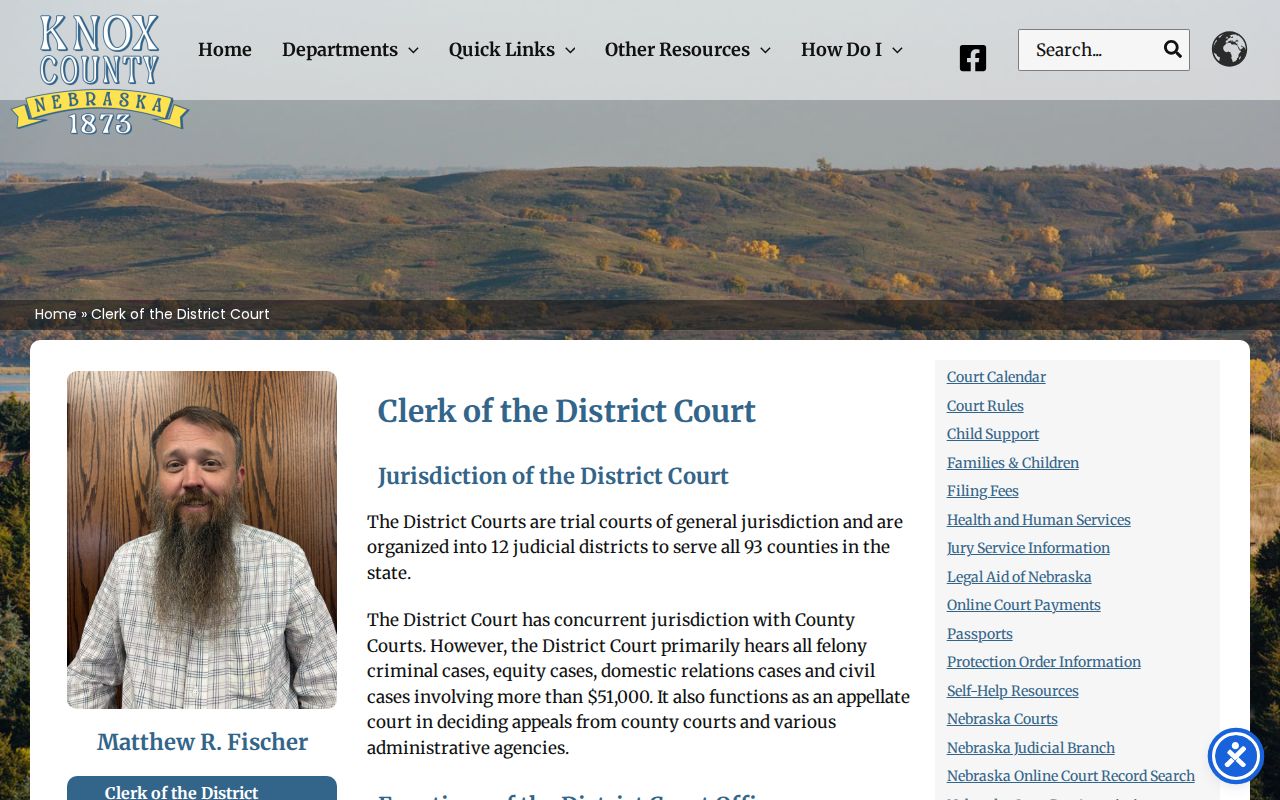
The District Court clerk page shows the separate felony and district-record route.
Inside a Knox County Arrest Warrant
A Knox County arrest-warrant record can list the case number, court, accusation, issue date, judicial officer, direction to the executing officer, bond or appearance terms, service or return, and register entries. That is the public view. The court file may hold more detail than any online result. Knox County publishes no local warrant-number format. Use only a number copied straight from the court.
| Complaint or charge | States the substance of the accusation and the case route. |
|---|---|
| Issuing judge | Identifies the judicial officer who authorized the process. |
| Executing authority | May name the sheriff, city or village police, or another authorized officer. |
| Bond or appearance | Case-specific instruction that must come from the court. |
| Return | Officer's report back to the magistrate after execution or attempted service. |
Knox County Arrest Warrant Service
Nebraska law directs a warrant to a sheriff, city or village marshal, or police officer, and other officers must aid in execution when required. The Knox County Sheriff's Office posts its service and jail duties. City police can hold statutory authority too. Not every office can answer the court's status question. That answer belongs to the clerk. For service or custody concerns, call the sheriff and jail at (402) 288-4261. For a court entry, try County Court at (402) 288-5607 or District Court at (402) 288-5606. The official sheriff page lists no warrant-unit number.
Serving Arrest Warrants in Knox County
The sheriff's published duties include serving, executing, and returning legal process in Knox County. A warrant can be executed anywhere in Nebraska. After arrest, the person goes before the proper magistrate. The endorsed warrant return then goes back to the issuing court. No public list shows those operational steps.
The state District Court contact page separates the trial-court record route from the sheriff's process role. Before any walk-in, call Knox County first. Ask which court, time, and bond direction apply.
Knox County Arrest Warrant Court
County Court is the first stop in Knox County for felony preliminary hearings, traffic, city-ordinalance matters, and misdemeanors. A felony file can start there. A District Court docket may come later. The clerk can say which record is public and which court controls the next setting.
Comparing Arrest Summonses and Bench Warrants
A summons, an arrest warrant, and a bench warrant all bring a case before a Knox County court. They just start differently. A summons commands an appearance without an immediate arrest. An arrest warrant follows probable cause on a complaint, while a bench warrant usually follows a missed duty or court-order problem. Read the exact document and register entry.
| Process | Starting point | Knox status source |
|---|---|---|
| Summons or citation | Command to appear or respond | Issuing court clerk |
| Arrest warrant | Complaint, affidavit, probable cause | County or District Court |
| Bench warrant | Missed appearance or noncompliance | Issuing judge and clerk |
Knox County Arrest Warrant Boundary
An arrest warrant authorizes taking a person into custody. A search warrant in Knox County is different: it authorizes a search of a specified person, place, or property. Nebraska §29-817 seals the application, affidavit, and testimony until execution. So an unexecuted search packet stays out of reach.
Access boundary: ask the court for the public portions of an arrest case, and do not treat a protected search-warrant application as an ordinary open record.
Read the Nebraska search-warrant statute for the specific restriction.
Knox County Arrest Warrant Return
Nebraska §29-412 requires the arresting officer to bring the person before the proper magistrate and deliver the endorsed warrant return. A return is not a roster status. Ask the Knox County clerk whether the file shows service, an appearance, bond, recall, quash, or a later setting. JUSTICE can display public register entries. New events can lag. And some documents stay restricted, so the issuing clerk remains the best source for a current answer.
If There's an Arrest Warrant for You
Call the issuing court. A Knox County clerk can explain what the case requires before you act. Get an attorney when possible. Phone the sheriff and jail before any voluntary surrender or appearance, and ask whether bond is set, where it is handled, and how the court records recall or clearance. The state ePayments portal offers no online bond payment.
Do not guess: a third-party list, payment receipt, or old case screen cannot replace the court's current direction.
- Identify the court and case number.
- Confirm the warrant and next court action with the clerk.
- Ask counsel about a motion, bond, or appearance.
- Ask the sheriff for safe process instructions.
- Keep written confirmation after the court acts.
Knox County's warrant records home gives the broader resolution chain.